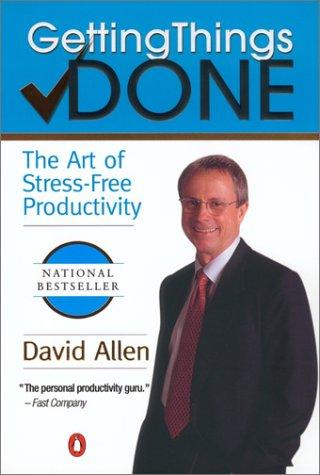
Allen's GTD methodology is built on a simple premise: your mind is for having ideas, not holding them — once every commitment is captured in a trusted external system and clarified into next actions, mental clutter and background anxiety drop dramatically, freeing capacity for actual focused work.
Key lessons
- Capture every commitment, task and idea in a trusted external system — nothing should be relying on memory alone.
- Clarify captured items into a concrete next physical action, not a vague intention — 'plan the launch' isn't actionable, 'draft launch email' is.
- Organise next actions by context (calls, computer, errands) so you can act on whatever's realistic in the moment.
- A weekly review keeps the whole system trustworthy — without it, the system quietly decays and stops being reliable.
Mental clutter from unclear, uncaptured commitments creates background stress that quietly drains focus — a trusted external system removes that drag entirely.
What’s aged well
The core capture-clarify-organise-review methodology remains a gold standard, widely adapted into modern task management tools.
What feels outdated
Some of the original physical filing system advice needs translating to digital tools, though the underlying logic transfers directly.
The Business Stuff verdict
A genuinely comprehensive system — takes real effort to set up properly, but repays that effort for anyone drowning in loose commitments.
Three things to actually do after reading it
- Do a full 'mind sweep' this week — capture every open commitment currently living only in your head.
- Convert your top five vague to-do items into specific, concrete next physical actions.
- Schedule a fixed weekly review slot to keep your task system trustworthy rather than letting it decay.
If you liked this, read next
Five similar books
- The One Thing (Gary Keller & Jay Papasan)
- The Checklist Manifesto (Atul Gawande)
- Eat That Frog! (Brian Tracy)
- Essentialism (Greg McKeown)
- Deep Work (Cal Newport)