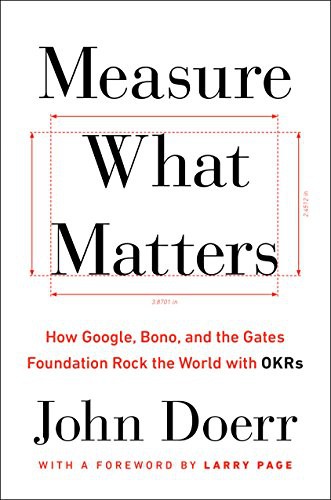
Venture capitalist Doerr, who introduced OKRs to Google in its early days, lays out the system — ambitious Objectives paired with measurable Key Results — through case studies at companies including Google, Intel and various non-profits, arguing that clear, public, regularly-reviewed goals dramatically improve execution.
Key lessons
- Objectives should be ambitious and qualitative; Key Results should be specific, measurable and time-bound.
- Goals set publicly and reviewed regularly get taken far more seriously than private, occasionally-checked intentions.
- OKRs work best set at multiple levels (company, team, individual) with genuine alignment between them, not in isolation.
- Stretch goals, deliberately set beyond comfortable reach, produce more real progress than safely achievable targets.
Clear, public, regularly reviewed goals — Objectives paired with measurable Key Results — produce dramatically better execution than vague intentions checked occasionally, at any team size worth coordinating.
What’s aged well
OKRs have become a standard goal-setting framework across many companies since publication, and the book remains the standard reference.
What feels outdated
Nothing significant; the framework remains widely and actively used.
The Business Stuff verdict
A genuinely practical framework, well worth implementing even in a simplified form for a smaller team.
Three things to actually do after reading it
- Write one ambitious Objective for the business this quarter, paired with two or three measurable Key Results.
- Make your team's current goals genuinely public and visible, not private to individual managers.
- Review your OKRs at a fixed, regular cadence rather than only at the end of the period.
If you liked this, read next
Five similar books
- Traction (Gino Wickman)
- Scaling Up (Verne Harnish)
- High Output Management (Andy Grove)
- Principles (Ray Dalio)
- Good to Great (Jim Collins)