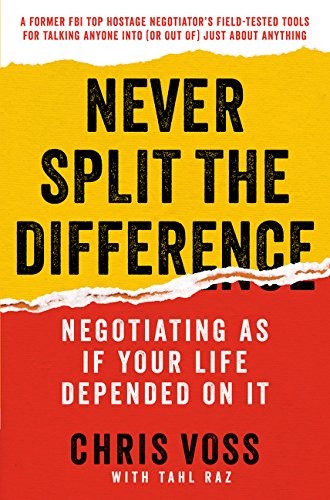
Voss, a former FBI lead hostage negotiator, applies the tactics of high-stakes crisis negotiation to everyday business situations. The central thesis rejects splitting the difference as a lazy, mutually unsatisfying compromise, and instead teaches specific, practical techniques — tactical empathy, mirroring, calibrated questions, the strategic use of 'no' — for getting to genuinely better outcomes than a straight 50/50 split.
Key lessons
- Tactical empathy — genuinely understanding and articulating the other side's perspective — gets better outcomes than pressure or aggression.
- Mirroring the last few words someone says, and using calibrated open questions ('how am I supposed to do that?'), draw out more information than direct demands.
- A well-placed 'no' often moves a negotiation forward faster than a 'yes' — people feel safer, and more open, once they've been allowed to say no.
- Labelling emotions out loud ('it seems like you're worried about...') defuses tension and builds trust faster than ignoring them.
- The goal isn't to 'win' a negotiation at the other side's expense — the best outcomes come from genuinely understanding what the other side actually needs.
Splitting the difference is usually a worse outcome for both sides than a negotiation built on genuine understanding of what the other party actually needs.
What’s aged well
The techniques are grounded in real, tested hostage-negotiation experience and translate cleanly to commercial negotiation without needing updates.
What feels outdated
Nothing meaningful — the tactics are essentially timeless human psychology.
The Business Stuff verdict
One of the most immediately useful books on this list — the techniques can be tried in your very next negotiation.
Three things to actually do after reading it
- Before your next negotiation, write down three calibrated 'how' or 'what' questions to draw out the other side's real position.
- Practise labelling emotions out loud in your next difficult conversation, even a small one, and notice the effect.
- Stop offering to 'split the difference' as a default — dig one layer deeper into what the other side actually needs first.
If you liked this, read next
Five similar books
- Influence (Robert Cialdini)
- Getting to Yes (Fisher & Ury)
- Bargaining for Advantage (G. Richard Shell)
- Thinking, Fast and Slow (Daniel Kahneman)
- Crucial Conversations (Patterson et al.)