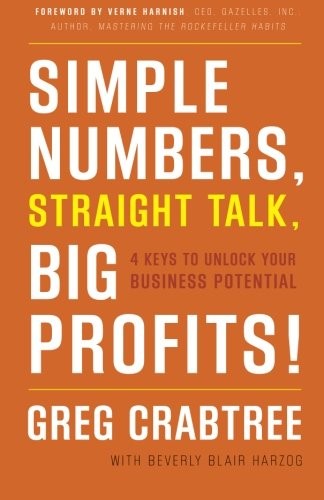
Written by a practising accountant, this book focuses on four keys to understanding a small business's real financial health, with particular emphasis on labour efficiency — how much revenue and profit each pound of labour cost is actually generating — a metric most owners never calculate.
Key lessons
- Labour efficiency — revenue generated per pound of labour cost — is one of the most revealing, underused metrics in small business.
- A target profit margin should be set deliberately by size of business, not left as a residual afterthought.
- Owner's pay needs to be clearly separated from business profit to see the business's real performance.
- Growth that doesn't improve labour efficiency is often growth that dilutes profitability rather than building it.
Most small business owners never calculate labour efficiency, yet it's one of the clearest signals of whether the business model actually works as it grows.
What’s aged well
The core metrics remain directly useful and are increasingly referenced in small-business financial coaching.
What feels outdated
Nothing significant; the metrics are structural, not trend-dependent.
The Business Stuff verdict
A genuinely useful, accountant's-eye view of small business numbers that most owners have never been shown.
Three things to actually do after reading it
- Calculate your own labour efficiency ratio this month, even roughly, if you've never done it before.
- Set a deliberate target profit margin for your business size, rather than accepting whatever's left over.
- Separate your own pay clearly from business profit in how you review the numbers.
If you liked this, read next
Five similar books
- Profit First (Mike Michalowicz)
- Financial Intelligence (Berman & Knight)
- Accounting Made Simple (Mike Piper)
- Five Numbers Every UK Business Owner Should Know
- The Personal MBA (Josh Kaufman)