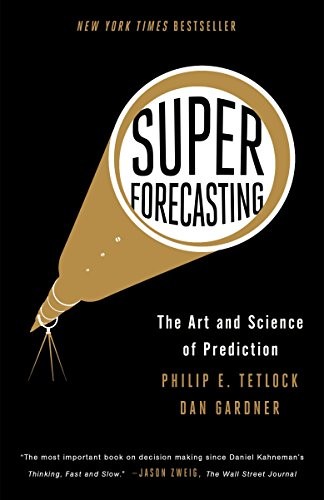
Drawing on a large, multi-year forecasting tournament, Tetlock and Gardner identify what actually distinguishes the small group of consistently accurate forecasters ('superforecasters') from typical experts, whose predictions often perform little better than chance. The answer is more about process and mindset than raw expertise.
Key lessons
- Expert credentials and confidence are poor predictors of forecasting accuracy — process and mindset matter more.
- Breaking a big question into smaller, more answerable sub-questions consistently improves forecast accuracy.
- Frequent, granular updating of a forecast as new information arrives beats a single confident prediction held rigidly.
- Actively seeking out disconfirming evidence, rather than just confirming your initial view, is a defining trait of accurate forecasters.
Forecasting accuracy is a learnable skill built from specific habits — breaking questions down, updating frequently, seeking disconfirming evidence — not a talent some experts simply have.
What’s aged well
The research findings remain influential and are increasingly applied in business forecasting and risk assessment.
What feels outdated
Nothing significant; the methodology is durable.
The Business Stuff verdict
A rigorous, genuinely useful guide for anyone whose job involves making predictions under real uncertainty.
Three things to actually do after reading it
- Break your next big business forecast into smaller, more specific sub-questions rather than one broad guess.
- Set a fixed cadence to revisit and update a current forecast as new information comes in.
- Actively look for one piece of evidence that would prove your current prediction wrong.
If you liked this, read next
Five similar books
- Thinking in Bets (Annie Duke)
- Noise (Kahneman, Sibony & Sunstein)
- Thinking, Fast and Slow (Daniel Kahneman)
- The Art of Thinking Clearly (Rolf Dobelli)
- Predictably Irrational (Dan Ariely)