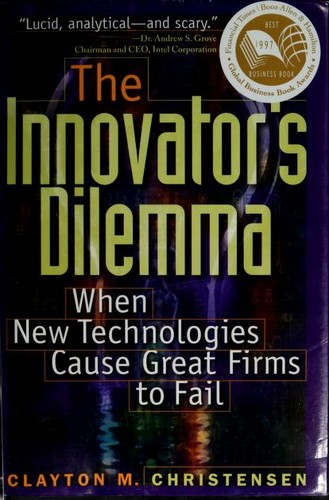
Christensen's foundational work on disruptive innovation explains a genuinely counterintuitive pattern: well-run, well-managed companies that listen carefully to their best customers can still lose their market to a cheaper, initially worse competitor — because that competitor started by serving customers the incumbent had no interest in, then improved until it was good enough for the mainstream market too. The 'dilemma' is that the very management practices that make a company excellent also make it vulnerable to this pattern.
Key lessons
- Disruptive innovations typically start by serving customers the market leader doesn't care about — the low end, or a market that doesn't exist yet.
- Listening closely to your best, most demanding customers can actively blind you to a threat emerging from a different, less profitable segment.
- Sustaining innovations improve existing products for existing customers; disruptive innovations create new markets with a different, often lower, value proposition.
- Resource allocation processes inside successful companies naturally starve genuinely disruptive projects, because they look unattractive next to the core business on normal metrics.
- The right response to a disruptive threat is often a separate, deliberately independent unit, not an attempt to force the parent organisation to change.
Being genuinely good at serving your current best customers is not protection against a competitor who starts by serving the customers you've written off.
What’s aged well
The disruption framework has held up remarkably well and is still the standard lens through which new market entrants are analysed today.
What feels outdated
The framework has occasionally been stretched to explain things it doesn't quite fit (Christensen himself pushed back on some later loose uses of 'disruption'), which is worth bearing in mind when applying it.
The Business Stuff verdict
Genuinely important for understanding competitive threats from below — dense, but worth the effort for any established business.
Three things to actually do after reading it
- List the customer segment your business currently has least interest in serving — and ask honestly whether a competitor could build there unnoticed.
- Check whether your product roadmap is entirely driven by your best, most demanding customers, and whether that's created a blind spot.
- If you're testing a genuinely different, lower-margin offer, consider running it as a separate small team rather than folding it into the core business.
If you liked this, read next
Five similar books
- Zero to One (Peter Thiel)
- Crossing the Chasm (Geoffrey Moore)
- The Innovator's Solution (Christensen & Raynor)
- Blue Ocean Strategy (Kim & Mauborgne)
- Loonshots (Safi Bahcall)