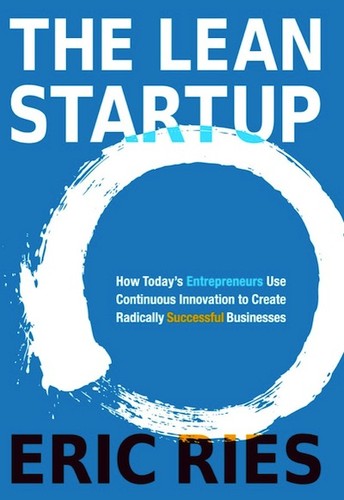
Ries takes the disciplines of lean manufacturing and applies them to the much messier problem of building something nobody's asked for yet. The central argument: treat a new business as a series of testable hypotheses rather than a fixed plan, get a Minimum Viable Product in front of real customers as fast as possible, and let actual behaviour — not opinions, including your own — decide what happens next.
Key lessons
- Build-Measure-Learn: get something real in front of customers before you've perfected it, then use what actually happens to decide the next move.
- A Minimum Viable Product is the smallest thing you can build to start the learning loop, not a cheap version of the full product.
- 'Validated learning' beats vanity metrics — track numbers that would genuinely change a decision, not ones that just go up and to the right.
- Be willing to 'pivot' — change a fundamental element of the strategy while keeping what you've already validated.
- Innovation accounting applies the same rigour to uncertain, early-stage bets that traditional accounting applies to established operations.
The fastest way to fail is to spend a long time building something in isolation before finding out whether anyone actually wants it.
What’s aged well
The build-measure-learn discipline and the emphasis on real customer behaviour over opinion are as relevant now as they were in 2011.
What feels outdated
Some of the specific tooling and web-startup examples feel dated, and 'MVP' has been so widely misused since publication (as an excuse for shipping something half-finished) that it's worth re-reading the original definition carefully.
The Business Stuff verdict
Essential for anyone building something genuinely new, even outside tech — the underlying logic transfers to physical products and services just as well.
Three things to actually do after reading it
- Write down the single riskiest assumption behind your current idea, and design the cheapest possible test for it.
- Pick one vanity metric you currently track and replace it with a number that would actually change a decision.
- Set a date to review whether to persevere or pivot on your current approach — don't let it drift indefinitely.
If you liked this, read next
Five similar books
- The Mom Test (Rob Fitzpatrick)
- Running Lean (Ash Maurya)
- Zero to One (Peter Thiel)
- The Four Steps to the Epiphany (Steve Blank)
- Sprint (Jake Knapp)