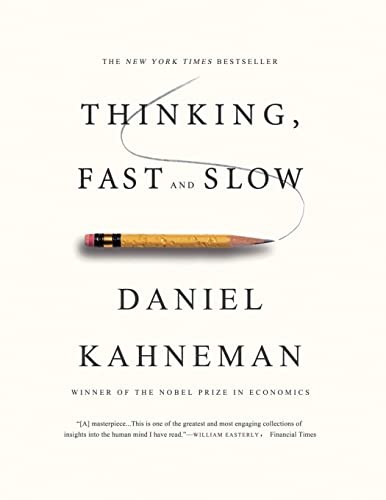
Nobel laureate Kahneman lays out decades of research into two systems of thought: System 1, fast, intuitive and emotional, and System 2, slower, more deliberate and logical. Most of our daily decisions run on System 1, which is remarkably efficient but also systematically biased in predictable, well-documented ways — biases that quietly distort business decisions from hiring to pricing to forecasting.
Key lessons
- System 1 (fast, intuitive) and System 2 (slow, deliberate) drive different kinds of decisions, and most of your day runs on System 1 without you noticing.
- Anchoring: an irrelevant first number can distort a decision even when you consciously know it's irrelevant — highly relevant to pricing and negotiation.
- Loss aversion: people feel losses roughly twice as strongly as equivalent gains, which shapes everything from pricing to how employees respond to change.
- The planning fallacy leads almost everyone to systematically underestimate how long and how much projects will actually cost.
- Overconfidence is the default state of expert judgement, not the exception — which is exactly why structured decision processes outperform gut calls on important decisions.
Your own judgement is systematically biased in specific, predictable, well-documented ways — building processes that account for those biases beats trusting instinct on the decisions that matter most.
What’s aged well
The core research remains foundational, though some individual studies cited have since had their statistical robustness questioned by the replication crisis in psychology — worth knowing, without undermining the book's broader framework.
What feels outdated
A handful of specific cited studies have faced later scrutiny; the core two-systems framework and most-cited biases remain well supported.
The Business Stuff verdict
Genuinely important, genuinely dense — worth the effort, best read in chunks rather than in one sitting.
Three things to actually do after reading it
- Before your next big decision, write down your gut call first, then deliberately list reasons it could be wrong.
- Check your next project estimate against the planning fallacy — add a realistic buffer based on past projects, not this one's optimism.
- Notice one pricing or negotiation anchor you've been influenced by recently, and test whether it was actually relevant.
If you liked this, read next
Five similar books
- Predictably Irrational (Dan Ariely)
- Influence (Robert Cialdini)
- Nudge (Thaler & Sunstein)
- The Undoing Project (Michael Lewis)
- Superforecasting (Philip Tetlock)