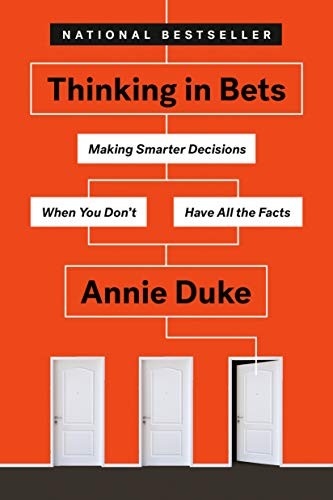
Former professional poker player Duke argues that we routinely confuse the quality of a decision with the quality of its outcome — a good decision can produce a bad result through bad luck, and vice versa — a distinction poker players are forced to internalise but most people never learn to separate.
Key lessons
- 'Resulting' — judging a decision purely by its outcome — leads to bad lessons, since good decisions can still produce bad outcomes through luck.
- Thinking in probabilities, not certainties, produces better decisions under genuine uncertainty than false confidence does.
- A 'decision group' of honest peers, willing to challenge your reasoning, improves decision quality more than deciding alone.
- Separating the quality of your process from the quality of the outcome is a discipline that has to be deliberately practised.
A good decision and a good outcome are not the same thing — learning to evaluate the quality of your reasoning, separately from how things happened to turn out, produces better decisions over time.
What’s aged well
The core distinction remains a genuinely useful, well-argued mental model.
What feels outdated
Nothing significant given recent publication.
The Business Stuff verdict
A clear, practical framework for making better decisions under real uncertainty — directly applicable to business calls made without full information.
Three things to actually do after reading it
- Review your last big business decision on the quality of the reasoning, separately from how it actually turned out.
- Form a small, honest group of peers willing to challenge your reasoning before a major decision.
- State your next big decision as a probability, not a certainty, and check back on the actual result later.
If you liked this, read next
Five similar books
- Thinking, Fast and Slow (Daniel Kahneman)
- Superforecasting (Tetlock & Gardner)
- Noise (Kahneman, Sibony & Sunstein)
- The Art of Thinking Clearly (Rolf Dobelli)
- Principles (Ray Dalio)